

Manufacturing Execution System (MES) Market Expected to Reach US$ 44.67 Billion at 13.3% CAGR by 2034
Fuel by Rapid adoption of Industry 4.0 and smart manufacturing, Need for operational efficiency and real-time visibility, and Stricter compliance & traceability │ The Insight Partners
New York, June 29, 2026 (GLOBE NEWSWIRE) -- The Insight Partners, published its latest market intelligence report on the Global Manufacturing Execution System (MES) Market . The study finds the market, valued at US$ 14.47 billion in 2025, is projected to reach US$ 44.67 billion by 2034, registering a compound annual growth rate (CAGR) of 13.3% over the 2025 - 2034 forecast period. Research draws on primary interviews with C-suite executives, OEM engineers, procurement heads, and policy analysts across more than 15 countries, augmented by proprietary databases and third-party validation.
Market Overview
A manufacturing execution system (MES) is a comprehensive, dynamic software system that monitors, tracks, documents, and manages the entire manufacturing process, from raw materials to finished products. An MES serves as a functional layer between enterprise resource planning (ERP) and process control systems, providing decision-makers with the data they need to improve plant floor efficiency. MES allows enterprises to track and control the whole manufacturing process, from raw material intake to finished product delivery. This involves handling work orders, checking product quality, monitoring machine performance, and collecting data throughout the production process.
MES software is used to manage, monitor, and coordinate the real-time physical processes and personnel involved in the conversion of raw materials into intermediate and/or completed commodities. It provides actionable data that assists manufacturing decision-makers in understanding how to optimize plant floor operating conditions to increase production output. MES software serves as a bridge between PLM, ERP systems (IT), and machines (OT). This software layer improves the efficiency and quality of the production process, resulting in greater productivity and profitability.
Latest research on the manufacturing execution system (MES market, covering market size forecasts, growth drivers, regulatory trends, and competitive insights. You may access the Sample document here: https://www.theinsightpartners.com/sample/TIPRE00006449/
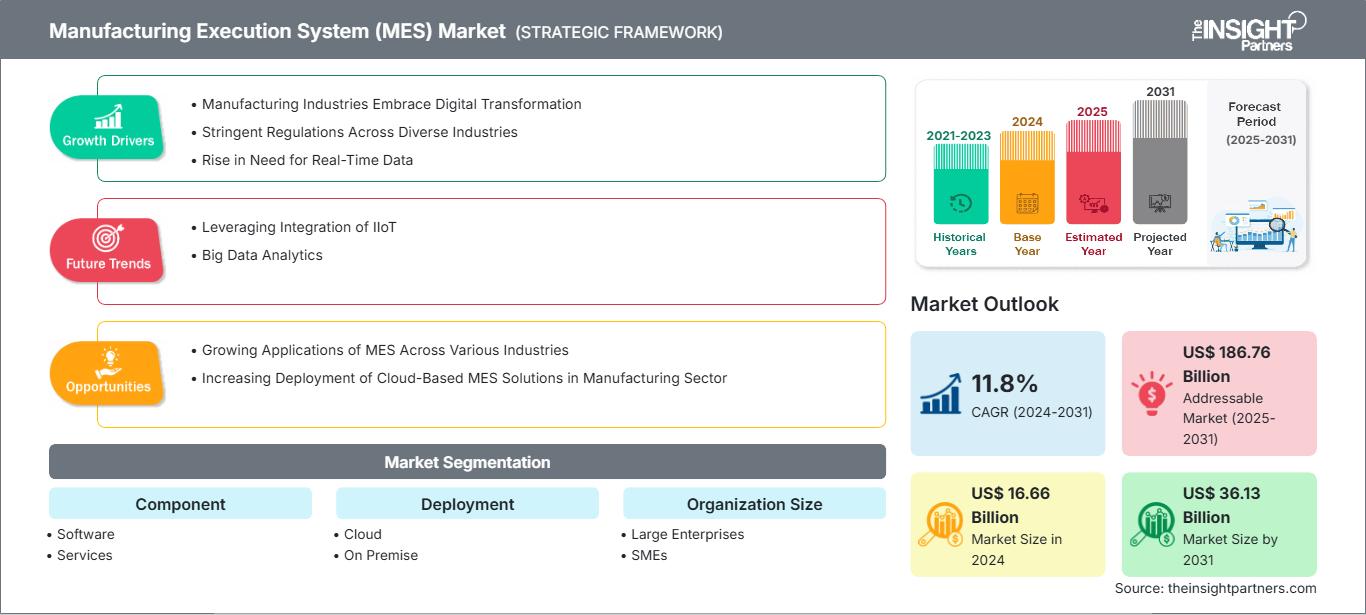
Key Market Findings
- Regional Leader: Asia Pacific is forecast to account for over 60% of global market share by 2034, led by China and Japan.
- North America: North America holds the second-largest share at over 38%, with the US market projected to grow at a 12.5% CAGR through 2034.
- Dominant Segment: Software retains the largest product segment share; dynamic software is used to monitor, track, document, and manage the entire manufacturing process.
- Fastest-Growing Segment: Cloud registers the fastest CAGR at 15.2% in North America, driven by accelerating enterprise digital transformation, hybrid workforce adoption, and rising investments in scalable cloud infrastructure solutions.
- Organization Size: Large Enterprises dominate by autonomous category, due to higher automation investments, complex operations, and scalability requirements.
Primary Growth Driver: Stringent Regulations Across Diverse Industries
MES ensures industry compliance through complete traceability and data recording. It records extensive information about the raw ingredients, components, processes, and operators involved in manufacturing. This data enables manufacturers to meet regulatory criteria and maintain high standards. MES can automatically document each stage of the manufacturing process, resulting in an audit trail required for regulatory inspections. It also analyzes quality control parameters in real time to ensure that products fulfill industry standards. If any deviations occur, MES can send alerts and take corrective action to ensure compliance. MES is the backbone of daily operations in the pharmaceutical sector, giving precise and real-time management over all aspects of the manufacturing process. In the pharmaceutical industry, MES facilitates electronic batch records (EBR) in accordance with stringent Good Manufacturing Practice (GMP) criteria. By deploying an EBR system, MES ensures that each production stage is accurately documented, lowering the risk of human mistakes and simplifying daily operations and administration. MES in the food and beverages industry meets legal and sanitary standards, such as Hazard Analysis and Critical Control Points (HACCP).
MES deployment in the food and beverages industry is best done in stages, commencing with chosen manufacturing lines or areas to minimize disruptions to the manufacturing process. Various players are offering MES for such regulated industries; Werum IT Solutions offers MES for the pharmaceutical and biopharmaceutical industries; it complies with regulations, such as FDA (21 CFR part 11). Thus, by keeping accurate records and providing real-time monitoring, MES assists manufacturers in adhering to industry standards and regulatory regulations, lowering the risk of noncompliance and improving product quality. Thus, stringent regulatory standards across various industries drive the growth of the manufacturing execution system (MES) market.
Discrete Industry: A High-Value End-Market
Manufacturing Execution Systems (MES) are transforming operations within the discrete industry by enabling end-to-end visibility, control, and optimization of production processes. Discrete manufacturing, which involves the assembly of distinct components into finished goods, requires high levels of precision, coordination, and traceability. MES addresses these requirements by bridging the gap between enterprise-level planning systems and shop-floor execution. Beyond improving productivity, order tracking, and lead time reduction, MES enhances production scheduling and sequencing by dynamically adjusting workflows based on real-time conditions such as machine availability, labor capacity, and material supply. This adaptability helps manufacturers respond quickly to demand fluctuations and minimize production disruptions. MES supports detailed genealogy and traceability, allowing manufacturers to track every component and process step, critical for quality assurance, compliance, and recall management. The system also strengthens quality management through in-process inspections, automated data collection, and statistical process control, reducing defects and rework. Workforce management capabilities enable better allocation of human resources, performance tracking, and training alignment. MES integrates seamlessly with advanced technologies such as IoT devices, robotics, and artificial intelligence, enabling predictive maintenance and data-driven decision-making.
Get a customized report to align these insights with your strategic business objectives - https://www.theinsightpartners.com/customization/TIPRE00006449
Segment Analysis
Cloud - Market-Leading Segment
Cloud manufacturing execution system (MES) is a software-as-a-service (SaaS) solution that uses software that operates over the Internet using a public cloud. This software allows users to access real-time operational data at any time. This connects departments and helps businesses monitor manufacturing execution systems, ERP, and supply chains to form integrated strategies based on the data collected. Moreover, cloud-based MES software is transforming industries by providing scalability, flexibility, and lower IT overhead. This software enables businesses to effectively expand their operations across multiple locations while enhancing collaboration, ensuring centralized data access, and facilitating decision-making throughout the enterprise. The cloud-based MES ensures that the data is securely saved and available remotely, allowing manufacturers to track production activities in real time from distant locations. The cost-effectiveness of cloud-based MES reduces the business's need for external infrastructure investment and maintenance, which surges the adoption among small and medium-sized enterprises (SMEs).
SMEs- Fastest-Growing at 14.6 % CAGR in North America
The growing use of manufacturing execution systems (MES) solutions in small and medium enterprises (SMEs) is associated with the surging need to increase efficiency and cost-effectiveness. SMEs' focus on increasing quality control, production efficiency, and operational monitoring drives the adoption of MES solutions. These solutions enable SMEs to monitor production processes in real time, optimizing resource consumption, reducing downtime, and minimizing waste. MES system monitors key performance indicators (KPIs) and delivers data-driven insights that help SMEs optimize production planning and scheduling. SMEs are adopting MES to automate several areas in their manufacturing process, including inventory management, quality checks, and work order tracking. This automation reduces human error and labor costs by automating several areas of the manufacturing process, including inventory management, work order tracking, and quality checks, making it a crucial tool for SMEs to improve operations while saving money.
Process Industry- Fastest-Growing
Manufacturing Execution Systems (MES) are advancing the efficiency and reliability of operations within the process industry, where production is continuous or batch-oriented and highly sensitive to process conditions. In addition to streamlining production and ensuring quality control, MES provides a centralized platform for managing complex workflows, standardizing operations, and maintaining consistency across multiple production lines and facilities. A key advantage of MES in the process industry lies in its ability to capture and analyze real-time data from distributed control systems (DCS), supervisory control and data acquisition (SCADA) systems, and field instruments. By continuously monitoring parameters such as temperature, pressure, flow rates, and chemical composition, MES ensures that production stays within defined specifications, reducing variability and enhancing product uniformity. This level of control is important in industries such as food and beverages, chemicals, and pharmaceuticals, where even minor deviations can impact safety and compliance. MES also strengthens batch management through electronic batch records (EBR), enabling accurate documentation, faster audits, and improved regulatory adherence. Automated data collection minimizes manual intervention, reducing human error and enhancing data integrity for better decision-making. MES enhances inventory and material management by providing real-time visibility into raw material consumption, work-in-progress, and finished goods, helping organizations optimize stock levels and reduce waste.
Chat with us - https://tawk.to/chat/5d56720577aa790be32f2bec/default
Regional Analysis
Asia Pacific - Largest and Fastest-Growing Market
Asia Pacific dominates the global market and is projected to account for over 60% of total market share by 2034. China remains the single largest national market; Japan is the fastest-growing major economy, supported by advanced manufacturing modernization and strong industrial automation investments. Canada is emerging as a fast-growing market, driven by rapid industrial digitalization, government manufacturing initiatives, rising factory automation adoption, and expanding smart infrastructure investments.
North America - Sustained by Strong Industrial Automation Demand
North America holds the second-largest share of the global market at over 38%. The US is the primary driver, with its manufacturing execution systems (MES) market forecast to grow at a 12.5% CAGR through 2034. North America is adopting MES solutions to reduce paper-based document usage, ease document storage operations, eliminate error-prone processes, and improve data access and analytics. According to Rockwell Automation, in April 2024, a client biopharmaceutical company deployed FactoryTalk PharmaSuite (an MES solution) in its Process Development division as a crucial first step toward digital transformation. PharmaSuite is a leading manufacturing execution system solution developed specifically for the life sciences industry.
Market Dynamics: Key Opportunities and Challenges
Acceleration of Industry 4.0 and Smart Factory Initiatives: The acceleration of Industry 4.0 is increasing MES adoption; it is redefining its role from a monitoring tool to a mission-critical execution and intelligence layer within smart factories. As manufacturers deploy interconnected ecosystems powered by the Internet of Things, autonomous robots, and cyber-physical production systems, the volume, velocity, and variety of data generated on the shop floor grow exponentially. MES platforms are uniquely positioned to contextualize this data in real time, translating raw machine signals into actionable production insights such as throughput optimization, quality deviations, and equipment utilization.
High Initial Implementation Cost of MES: The upfront costs of implementing a manufacturing execution system (MES) include the acquisition of software licenses, hardware infrastructure, and expenses related to system deployment and configuration. The cost of software licenses can vary considerably depending on the required functionality and the number of users. Hardware expenses may cover the purchase of servers, networking devices, and other essential components for system integration. The cost of implementing a manufacturing execution system (MES) is influenced by several factors, including the scale and complexity of operations, the specific features needed, and the chosen software provider. Additional expenses may arise from customization requirements and integration with other systems, such as ERP or SCADA. The cost of implementing a manufacturing execution system (MES) can differ widely. For a mid-sized company, the implementation cost falls between ₹ 2.8 crore (US$ 0.32 million) and ₹ 4.9 crore (US$ 0.56 million). For larger organizations, the cost tends to range from ₹ 6.2 crore (US$ 0.71 million) to ₹ 9.8 crore (US$ 1.13 million).
Purchase the full report from The Insight Partners upto 40% Discounted Price - Manufacturing Execution System (MES) Market
https://www.theinsightpartners.com/buy/TIPRE00006449/
Recent Industry Developments (2025 - 2026)
Oracle Manufacturing Execution System enhances manufacturing operations
In January 2025, Oracle Manufacturing Execution System enhances manufacturing operations by enabling improved enterprise collaboration through precise, agile, and scalable functionalities. It plays a critical role in providing real-time visibility into production activities while supporting complex ERP integration requirements. The solution is designed to address the challenges of both discrete and process manufacturing environments by delivering intuitive tools that streamline shop floor execution, improve operational efficiency, and strengthen end-to-end manufacturing control.
JSW Motors has partnered with Dassault Systèmes to strengthen the development of its new energy vehicles
In March 2026, JSW Motors partnered with Dassault Systèmes to strengthen the development of its new energy vehicles by adopting an advanced digital platform. The collaboration focuses on deploying the 3DEXPERIENCE system to integrate design, engineering, and manufacturing processes into a unified ecosystem. As part of this, the company will implement a Manufacturing Execution System (MES) to enhance production monitoring, ensure real-time data visibility, and improve operational efficiency.
Leading Manufacturing Execution System (MES) Companies
| Company | Profile |
| SAP SE | Global leader in MES and industrial software solutions, enabling smart manufacturing, production planning, and real-time factory analytics. |
| ABB Ltd | Industrial automation company providing MES platforms integrated with robotics, digital manufacturing, and process optimization technologies. |
| Dassault Systèmes SE | Provides MES solutions through DELMIA applications, supporting digital manufacturing, virtual production, and lifecycle management systems. |
| Schneider Electric SE | Offers MES and industrial automation software focused on energy efficiency, smart factories, and operational performance management. |
| Infor | Develops cloud-based MES solutions tailored for manufacturing industries, emphasizing production visibility and operational efficiency improvements. |
| Honeywell International Inc. | Provides MES and industrial digitalization solutions supporting process automation, connected plants, and predictive manufacturing operations. |
| Rockwell Automation Inc. | Specializes in MES and factory automation platforms for real-time monitoring, industrial control, and manufacturing optimization applications. |
| Siemens AG | Major MES provider delivering digital manufacturing software, industrial IoT integration, and smart factory management solutions globally. |
| PSI Software SE | Develops MES and production management software focused on process industries, factory scheduling, and operational transparency solutions. |
About The Insight Partners
The Insight Partners is a globally recognized market research and management consulting firm specializing in technology, media, telecommunications, healthcare, and industrial sectors. Research methodology integrates primary data collection including executive interviews, OEM surveys, and channel partner analyses with proprietary secondary research databases and econometric modeling. Reports are used by Fortune 500 companies, private equity firms, government agencies, and institutional investors to inform strategic planning, M&A, and capital allocation decisions. The firm maintains research coverage across 50+ industries and 100+ countries.
Report Link: https://www.theinsightpartners.com/pr/manufacturing-execution-system-market
Request for a free demo of The Insight Partners’ Manufacturing Execution System (MES) Market & Intelligence Platform
Media Contact: The Insight Partners | sales@theinsightpartners.com | www.theinsightpartners.com
Also Available in : Korean | German | Japanese | French |Chinese | Italian | Spanish


Legal Disclaimer:
EIN Presswire provides this news content "as is" without warranty of any kind. We do not accept any responsibility or liability for the accuracy, content, images, videos, licenses, completeness, legality, or reliability of the information contained in this article. If you have any complaints or copyright issues related to this article, kindly contact the author above.
